
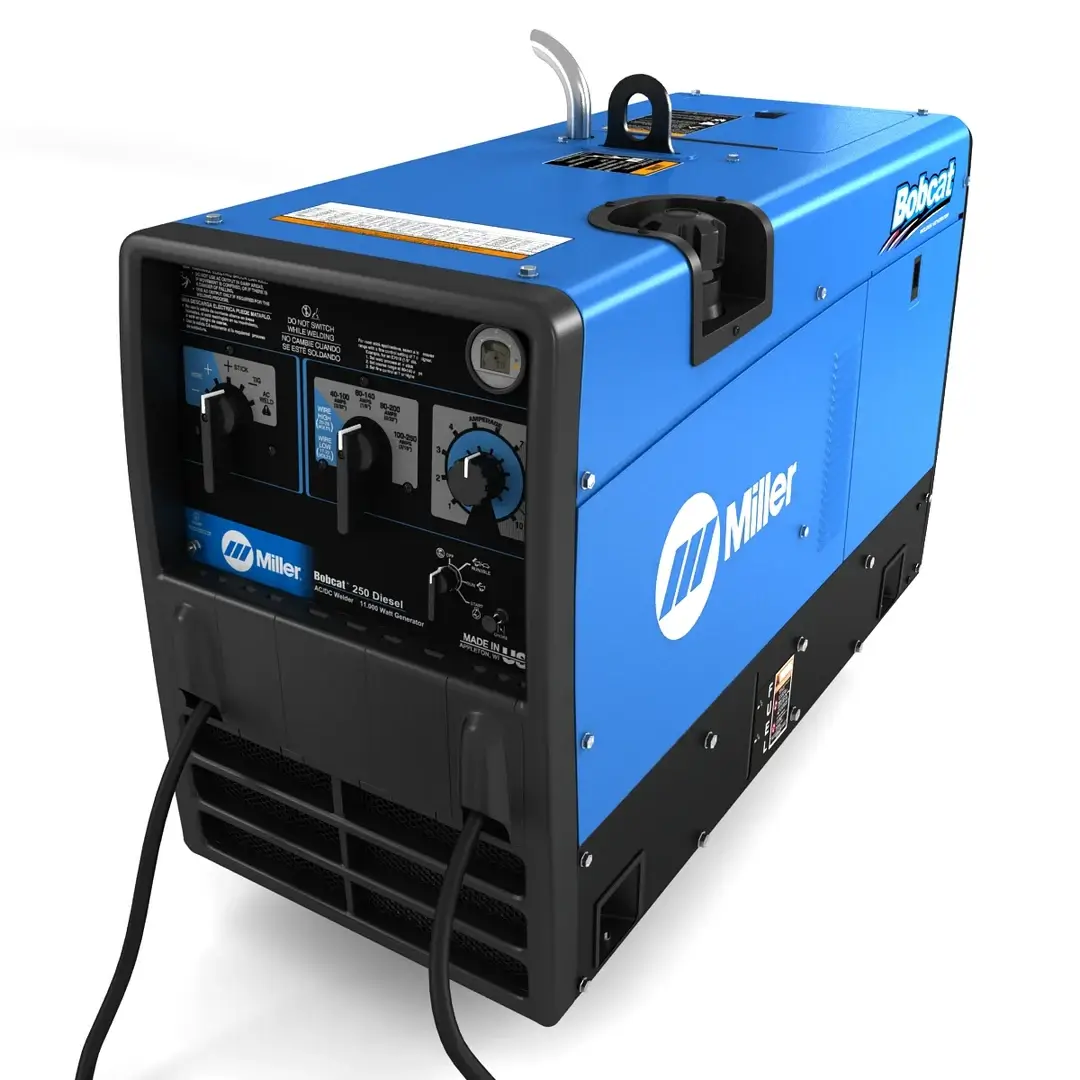
Miller Bobcat 250
Miller Bobcat 250 Overview
What the machine does
The Miller Bobcat 250 powers work far from shop outlets. Crews run it on pipeline repair, structural steel, farms, ranches and service trucks. It leads the industry as the best-selling engine-driven welder/generator.
One reason explains that lead. A single machine runs stick, MIG, flux-cored and TIG. It also doubles as a jobsite generator.
Why buyers pick the 250 over the 225
The 250 sits one step above the Bobcat 225. That step buys real capability.
Against a 225-amp welder/generator, the 250 delivers 72 percent more power for MIG and flux-cored work. It adds 67 percent more for AC welding and 11 percent more for DC stick. It also gouges with air carbon arc, which the 225 cannot do.
Models and redesign
Miller sells the 250 in four versions: carbureted gas, EFI gas, LP and diesel. All four share the same weld output. They differ in engine, runtime, weight and price.
Miller’s engineers redesigned the platform a few years back. They cut sound by as much as 33 percent. They also trimmed up to 5 inches of height and 55 pounds of weight.
Miller Bobcat 250 Specifications
Core spec table
| Specification | Bobcat 250 (Gas, Kohler) |
|---|---|
| Processes | Stick, MIG, Flux-Cored, TIG, air carbon arc, plasma (optional Spectrum) |
| Rated Output | CC/AC Stick/TIG: 250 A / 25 V / 60% CC/DC Stick/TIG: 250 A / 25 V / 100% CV/DC MIG/FCAW: 275 A / 25 V / 60% CV/DC MIG/FCAW: 250 A / 28 V / 100% |
| Weld Output Range | AC Stick/TIG: 40–250 A DC Stick/TIG: 40–250 A MIG/FCAW: 17–28 V |
| Generator Power | 11,000 W peak / 9,500 W continuous |
| Engine | Kohler CH730, 23.5 hp @ 3,600 rpm |
| Fuel Capacity | 12 gal (45 L) |
| Oil Capacity | 1.5 qt (1.4 L) |
| Sound Level | 72 dB idle, 73 dB welding |
| Weight | 501 lb (227 kg) |
| Dimensions | H 28 in × W 20 in × L 40.5 in |
| Idle Speed | 2,300 rpm |
| Weld Speed | 3,600 rpm |
How the variants differ
The LP model runs a Kohler CH730 making 21 hp. It puts out 10,500 watts peak and 9,500 watts continuous. It weighs 560 lb (254 kg).
The EFI model pushes output to 12,000 watts peak and 10,500 watts continuous. It uses a Kohler ECH730 rated 23 hp at 3,600 rpm.
The diesel uses a 19 hp Kubota. It weighs 638 lb (289 kg) on a 45.375-inch frame.
Warranty
Miller warrants the welder/generator for three years, parts and labor. The engine maker warrants the engine separately.
Miller Bobcat 250 Features
- Tri-Cor technology smooths the arc and steadies generator power while you weld.
- Maintenance display flags service time. A wrench icon appears at each interval.
- Front-panel gauges show fuel level at a glance. You skip the climb onto the deck.
- Idle lock switch holds weld speed instead of dropping to idle between arcs.
- Lift eye comes standard. Running gear, cart and trailer mount as options.
- Low oil pressure shutdown stops the engine before damage sets in.
- Enclosed case wraps a packaging design that runs cooler and more efficiently.
- EFI option stretches runtime as much as 27 percent. It starts without a choke, resists fuel deterioration and cuts emissions.
Miller Bobcat 250 Welding Output
Process range
The 250 runs constant current and constant voltage. It runs AC and DC. That range lets it serve as the only power source on a truck.
Stick (SMAW)
The machine covers 40–250 A on AC stick. It covers 40–250 A on DC stick as well. DC runs smooth and easy. Reach for AC stick when arc blow shows up.
MIG and flux-cored
The 250 drives a suitcase feeder across 17–28 V. It rates 275 A at 25 V at 60 percent duty cycle. It also rates 250 A at 28 V at 100 percent.
TIG
The machine supports DC TIG above 80 amps. Miller lists AC TIG as non-critical work only. This transformer machine will not match a squarewave inverter on thin aluminum.
Gouging and plasma
The 250 gouges with 3/16-inch carbons. The 225 cannot take that job. Pair the machine with optional Spectrum models and cut with plasma off the auxiliary power.
Miller Bobcat 250 Generator Power
Rated output
Standard gas and LP units put out 11,000 watts peak. They hold 9,500 watts continuous. Miller rates that output at 104°F (40°C).
That rating detail matters. Cooler test temperatures flatter a spec sheet but fail you in August. The machine holds peak power for a minimum of 30 seconds. That window spins up motors and compressors.
Auxiliary power arrives at 120/240 VAC, 88/44 A, 60 Hz.
Power while welding
One figure decides most jobs: power while the arc burns. Weld at 250 amps and the Bobcat still hands you 2,200 watts.
That covers grinders, lights and a small compressor. Full output covers plasma cutting, Millermatic MIG welders and motor starting.
Load the generator hard and often, and the EFI version earns its premium.
Miller Bobcat 250 Engine and Fuel System
Gas, EFI and LP engines
Gas and LP units run the Kohler CH730. It is a twin-cylinder, four-cycle overhead valve industrial engine.
Gas units make 23.5 hp at 3,600 rpm. LP units make 21 hp. Both turn 3,600 rpm at weld speed and 2,300 rpm at idle.
The tank holds 12 gallons (45 L). The crankcase holds 1.5 quarts (1.4 L). Low oil pressure shutdown protects the engine.
The EFI model swaps in the Kohler ECH730 at 23 hp. It carries the same three-year warranty.
The diesel option
The diesel version runs a 19 hp Kubota. It trades horsepower for fuel economy and service life. Rental fleets and pipeline crews favor it.
Keep the fuel clean. The diesel engine shuts itself down on its protective circuits.
Picking a fuel
Your duty cycle should pick the fuel. Carbureted gas costs least and services easiest.
EFI pays back on high-hour machines. It adds runtime, starts without a choke and keeps fuel stable.
LP suits enclosed sites and idle machines. Diesel fits fleets that already stock it.
Miller Bobcat 250 Maintenance
Reading the display
The onboard display removes the guesswork. Shut the engine off first.
Move the Engine Control switch to Run/Idle to read engine hours. Move it to Run to see hours before the next oil change. The counter starts at 100 and drops to zero.
Negative hours mean you passed the interval. Cycle the switch from Run/Idle to Run three times within five seconds to reset it.
Service intervals
- 50 hours — clean and tighten the weld terminals
- 100 hours — change the oil, clean the cooling system, check the air cleaner, tighten the battery connections
- 200 hours — change the oil filter, replace the fuel filter, check the spark plugs
- 500 hours — service brushes and slip rings, replace cracked cables, check valve clearance
- 1,000 hours — blow out the inside, and do it monthly during heavy service
Severe conditions tighten the schedule. Change the oil every 50 hours instead of 100. Keep the filter on its 200-hour cycle.
Many Miller service techs go further. They change the first oil at 50 hours, then settle into 100-hour changes.
Oil rules
Two rules deserve respect. Kohler rules out straight-weight oil in these engines. Synthetic improves cold starts but does not extend the interval.
Match the viscosity on the label under the top door. Park level after fueling and check the dipstick. Add oil only to the full mark.
Miller grouped the service points for speed. Oil fill, level check, fuel filter and drain sit together.
Miller Bobcat 250 Manual
Finding the right version
Miller publishes owner’s manuals free at millerwelds.com. The site indexes them by serial number.
Check the rating plate first. The Bobcat 250 has passed through several revisions. The earlier 250 NT even used Onan engines. Wiring diagrams and part numbers change between them.
Sections operators use most
Operators reach for four sections. They cover routine maintenance, oil and filter changes, control descriptions and troubleshooting.
Take a no-start as an example. The manual walks you through the fuel level, battery voltage, battery connections and oil level. It then sends you to the low oil pressure shutdown switch. A Factory Authorized Service Agent checks the fuel shutoff solenoid.
Engine documentation
Engine service lives in a separate book. Miller sends you to the Kohler or Kubota manual for oil and filter work. A complete parts list also sits at millerwelds.com.
Miller Bobcat 250 FAQs
How many watts does a Miller Bobcat 250 make?
Standard gas units make 11,000 watts peak and 9,500 watts continuous. The EFI model makes 12,000 watts peak and 10,500 continuous. LP units make 10,500 peak and 9,500 continuous.
Can you weld and run the generator at the same time?
Yes. Weld at 250 amps and the machine still supplies 2,200 watts. That covers grinders and lights, but not a plasma cutter.
Which engine does the Bobcat 250 use?
A Kohler CH730 makes 23.5 hp on gasoline or 21 hp on LP. The EFI model uses a Kohler ECH730 at 23 hp. The diesel uses a 19 hp Kubota.
How much does a Bobcat 250 weigh?
Gas units weigh 501 lb (227 kg). LP units weigh 560 lb (254 kg). Diesel units weigh 638 lb (289 kg).
How often should you change the oil?
Change it every 100 hours normally. Cut that to 50 hours under severe conditions. Change the filter every 200 hours.
How long does a tank last?
The tank holds 12 gallons (45 L). Load and idle habits drive runtime. EFI units stretch it as much as 27 percent.
How loud does it run?
It runs 72 dB at idle and 73 dB while welding. That lands up to a third quieter than the older model.
What does the warranty cover?
Miller covers the welder/generator for three years, parts and labor. The engine maker covers the engine separately.
Reviews
There are no reviews yet.